

In the dark of the CORE Dance Studio, tucked away in the Decatur Square, a small audience of 36 could hear the padding of dancers’ feet as they got into position for Lullaby, the latest performance by the Agnes Scott Creative Arts Department. The show ran from October 9th through 12th and featured performers from Studio Dance Theater.
The performance itself is a meditation on the shared trauma many have been experiencing in the wake of Donald Trump’s first administration in 2016, and continuing today. Particularly, it focuses on deportation, a testament to the tragedies that are occurring, but also to the strength of immigrants and immigrant communities.
See the people sitting here.
Each person represents a unique story, a distinct path through life.
Yet despite our differences, we share something extraordinary.
Something that goes beyond the surface of our skin or the languages we speak.
The show opens with a familiar tune, the song is “Lullaby Medley,” by Michael Ogletree, but the feeling it inspires is reminiscent of childhood. As the dancers, members of Agnes Scott’s Studio Dance Theater, come forward to take their places, they open their long white skirts to the audience, a show of vulnerability, innocence, and trust. Projected across the stage, and across their skirts, read the words “love,” courage,” and “hope.” These words are a recurring motif in the show, despite the dark themes later on. Once the dancers find their places, they begin a gentle sequence, their long white skirts flowing with their movements. As the audience watched the dancers twirl and glide across the stage, they were transported back to a state of childlike wonder. Towards the end of this first movement, dancer Ryan Barber begins to speak. “See the people sitting here…” she reads, the words coming from Myrtle Ladner’s 6 Short Speeches on Humanity. After we spend a few more minutes basking in the childlike moment, the performers are swallowed by the darkness of the space, and a new feeling arises.
Every language has words for love, courage, and hope.
Every society values family, friendship, and community.
These universal traits show how similar we are at our core.
Behind our different clothes, customs, and beliefs lie the same hopes and fears.
We all want safety for our children.
The music goes silent as Barber returns to the stage to read another short passage, before sitting down in the audience as the lights go down again. Then, all at once, the room is illuminated with a dim pinkish glow, and the dancers stand in a line, marching to the rhythm of another childhood classic, Twinkle Twinkle Little Star. Though the song, as you know it, might seem gentle and sweet, together with the ominous beat created by the dancers’ movements and their militaristic demeanor, it takes on a more ominous feeling. The drastic change from the beginning of the show feels like a loss of innocence, the dancers becoming aware, trying for a distorted adulthood. This is reinforced when Barber’s voice reappears from the audience, periodically reciting lyrics from Stephen Sondheim’s Children Will Listen. The words serve to remind the audience that the dancers imitating military drills on stage are the same people who were twirling in childlike innocence a mere five minutes before.

As the choreographer and director of studio dance theater, Bridget Roosa, puts it, “the piece was made to say, ‘if we are not careful, we are going to influence children, and children are the future.” This message is especially potent, knowing that the dancers are all students, most of whom were coming of age and gaining an understanding of the world during President Trump’s rise to power. They watched as his administration began ramping up mass deportations, causing family separations at the U.S.-Mexican border and many cases of missing persons, deaths, and instances of severe trauma.
After Barber says her final words, “Careful the tale you tell, That is the spell, Children will listen,” and the lights go down once more, we enter into a world of red. The next sequence, titled Line in the Sand, has an anxious feeling that rarely goes away throughout the rest of the show. We see two dancers, Barber and Angela Seoung-Mathews, holding a balled-up length of black tulle. Seoung-Matthews dances away from Barber, unfurling the fabric as she does so. The fabric is fully unravelled, spanning the width of the stage and creating a vast distance between the dancers, which reflects the rising polarization in our political climate.
The music stops, and the graduating senior in the production, Sofia Tovar, drags herself onto the stage on all fours, crawling beneath the fabric. The sound of her limbs on the ground stands out against the silence as she makes her way across the stage. Still in silence, other dancers begin to make their way to the stage by way of the audience to begin an ominous number performed in silence. Every sound the dancers make is amplified throughout the small room as we see a haunting mirror of an earlier scene. The dancers line up as Tovar makes her way across the stage, stopping to dance with each figure as she passes.
Soon, the music returns, and there’s a shift. Where before the red light was tragically discordant, it now accompanies rapid movements and determined faces. The mismatched vests worn by the dancers take on a new life, representing working-class immigrants, just trying to keep their families fed throughout a tumultuous time.
The anxious undercurrent of the show is brought to the forefront of our minds as a bar of static is projected onto the back wall. Throughout this piece, the dancers circle under and around the black fabric, our metaphorical line in the sand. They are caught in between, living on the edge of two worlds. At points, the dancers look trapped on one side of the stage, the music picking up and slowing down, anxiety ever-present. As much as the dancers play with and manipulate the tulle, holding it, or looking through it towards the audience, they also manipulate each other’s bodies, occasionally appearing like marionette dolls, being both controlled and supported.

The red lights, which at this point have been bright so long that the scene looks unreal, almost morphing into something sinister, gradually fade. As all the figures on stage stop and stare directly at the audience, a cool white light illuminates the angles of their faces, providing visibility, but not a lighter mood. Barber begins to sing. After a few moments, the rest of the dancers join her, humming along to the tune. With the speakers cut out, their voices take on an ominous tone, sobering to the viewer. Tovar stumbles, seemingly shot in the chest. She limps her way between the humming dancers, who soon make their way solemnly off the stage, and the lights turn purple.
The room is filled with sound once again as You Are My Sunshine begins to play. Barber walks across the stage, taking the line of tulle with her. Dancers begin to emerge from each side of the stage, one at a time, and walk, looking forward only to the other wing. During their path, they each drop their vest to the ground, not even pausing, just continuing off the other side of the stage. The calm scene continues, the dancers solemn. After each dancer has made their way across the stage, Tovar rushes on, frantic to retrieve the pieces her peers had lost. She frantically rocks back and forth, as if holding close the last remnants of those she had lost, either to death or deportation. It’s a poignant message in today’s climate, when immigrants are often discussed as numbers or anecdotes, to see a story so vulnerable and tragic. The entire show feels deeply and innately human. Tovar resembles a child as she holds the bundle of clothes and looks out to the audience, and the words to the song say, “Please don’t take my sunshine away.” It feels like a plea, one that we have seen time and time again met with cruelty. As the lights go down once more, the audience is left with an unavoidable truth: every person deported, every worker having to endure brutal conditions to bring home enough money, every human being held in a detention facility, and every victim of police brutality is somebody’s sunshine. And we keep taking them away.
Through centuries of progress and setbacks, humans have shown remarkable resilience.
We’ve faced plagues, wars, natural disasters, and countless challenges.
Still, we persist, rebuild, and move forward together
The lights go blue. As they crouch across the stage in groups, the student dancers whisper to each other in sequence: “Itsy, bitsy, wash.” They imitate spiders as they make their way to one side or another, only to be pushed back from where they came. This number is a testament to the physical and emotional labor done by migrants in this country. In this context, the piece takes on a sad meaning, but those on stage seem unaware of this, their determination overshadowing. As they dance, the studio’s back wall becomes a canvas. Someone appears projected onto the wall, climbing. This is the work of Agnes Scott Creative Arts professor Nell Ruby. The inverted and distorted video is just one of the slides projected onto the stage throughout the show. In an interview, Ruby said that they intended to evoke, not tell, the message of the piece. And evoke it did. While there are obvious connections to be made with the imagery that has flooded our newsfeeds of people climbing over the wall at the US-Mexico border, there is something more behind the dance and projections. Climbing becomes a metaphor for the resilience of immigrant communities. As the dancers come together, we are reminded of the courage it takes to be an immigrant in this country. But the piece retains a sad tone. The dancers don’t seem to be getting anywhere; there’s no end in sight. A pessimistic viewer might begin to wonder if it’s futile. The dancers seem on edge, like they’re at risk of burning out. It is at once a testament to their strength and to the strain that comes with existing as an immigrant.
After a few final spiders attempt to cross the stage and are swept into the wings, other dancers, now wearing tan pants, begin to attempt to stomp across, as the lights come up slightly. It is a stark contrast to the previous scene, dancers now claiming their space, where before they crouched. As the dancers attempt to cross, they are stopped by Tovar, standing in their way, and retreat. Soon, the dancers come more frequently. Eventually, they begin to swarm, and Tovar’s costume changes as she is absorbed into the crowd.
The dance that follows is as determined as those before, but we feel a sense of hope that has been absent since the first number. Roosa says that this piece was inspired by the feeling she experienced when Georgia turned blue in the 2020 presidential election. It felt like a breaking point, a moment where the people stood up and said, “We won’t take this anymore.” The tone is reflected in the piece, in which dancers move assuredly through their own space. After this piece, we move into a final segment, which highlights the optimism that persists throughout the harm.
The closing dance settles into a solemn, careful hope. Row, Row, Row Your Boat becomes a quiet pulse under soft pink light as dancers stand with their feet inside the openings of their long skirts, the fabric fanned around them like lily pads. Movements are synchronous and gentle, a slow ritual of repetition that echoes motifs from earlier in the work. Marley Crosby, the rehearsal assistant, separates from the chorus, holding her skirt aloft like a hovering ghost, a metaphor for the grief caused. Projections that have been a scattered word cloud throughout the piece narrow and simplify until a single word, Rebuild, hangs whole and centered over the company. The effect is deliberate: fragmentation resolved into an intention, grief folded into a practical, communal resolve.
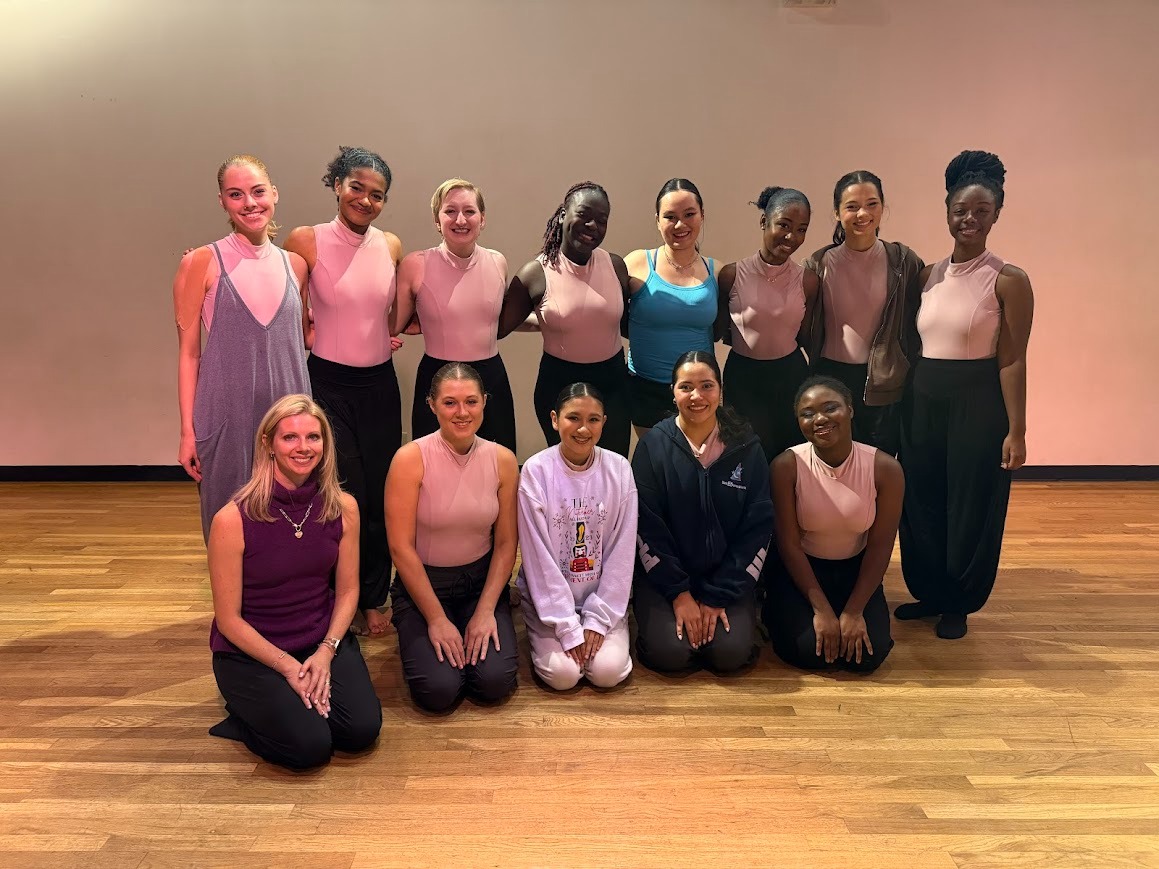
Studio Dance Theater’s Lullaby refuses tidy answers. It stitches together vulnerability and anger, mourning and insistence, so that the political stakes feel intimately human. Roosa’s piece asks us to recognize that each deportation, each worker pushed to the margins, is not an abstraction but a life whose absence reshapes a community. The performance doesn’t pretend to solve those harms; instead, it insists we remember them, care for one another, and translate that care into collective action. Walking out of the studio, the urgency isn’t a demand for catharsis but a quiet summons: to keep rebuilding what has been broken and to protect the fragile lights others call their sunshine.


Be First to Comment