


If you happened to walk past the open doors of the Frannie between 10:00 AM and 4:30 PM on Saturday, September 24th, you would have been greeted with a series of brave and passionate readings of poetry from guests of the college and Scotties alike. As the early morning post-Red-Light-Green-Light haze blanketed the rest of campus, Frannie auditorium was alive with the sharing of art, of ideas, and of emotion. The occasion? The English Department’s second departmental event of the semester: 100k Poets for Change.
The event was hosted by Professor Waqas Khwaja and involved four sessions of virtual and in-person readings of original poetry and works by other writers. I managed to make it for the tail end of the second session and all of the third. In that time, I saw readings from two current Scotties, one ASC alum, a professor from the French Department, and seventeen other guest speakers.
The sessions featured works by poets of many different backgrounds and, thanks to the magic of Zoom, from all across the globe! Poems came in different formats, different lengths, were read in different languages, including Spanish and Urdu, and covered different subject matters like indigenous diaspora, gun violence, and the color white.
The second session ended with readings in Spanish from Sergio Inestrosa and Elisa Corona Aguilar, and an original work by a current Scottie. Both Inestrosa and Aguilar recited their work stanza by stanza, first in the original Spanish before reading the translated lines in English, and despite the differences between the two languages, the works of both poets moved the audience with their striking words. To close it out, Libby Klein, a sophomore at Agnes, read an original poem titled “The Doctor Who Bore Me,”about her chronic pain condition and experience dealing with the diagnostic process. The poem features powerful repetition and a twisting command of language that allowed her to develop and express a deeply personal understanding of the narrator’s battle with diagnosis and pain.
The third session began with a reading from Dr. Nishi Chawla, a novelist, academic, playwright, screenwriter, and poet. She read from one of her most recent collections of poetry, which takes a look at colonization and the indigenous experience. Her poem was titled “The Cartographers of Loss” and explored the tension between a changed landscape and those indigenous to the land who can no longer recognize it. “To be displaced is to be unthreaded,” she read, a line that pierced the overwhelming experience of indigenous diaspora like a needle.
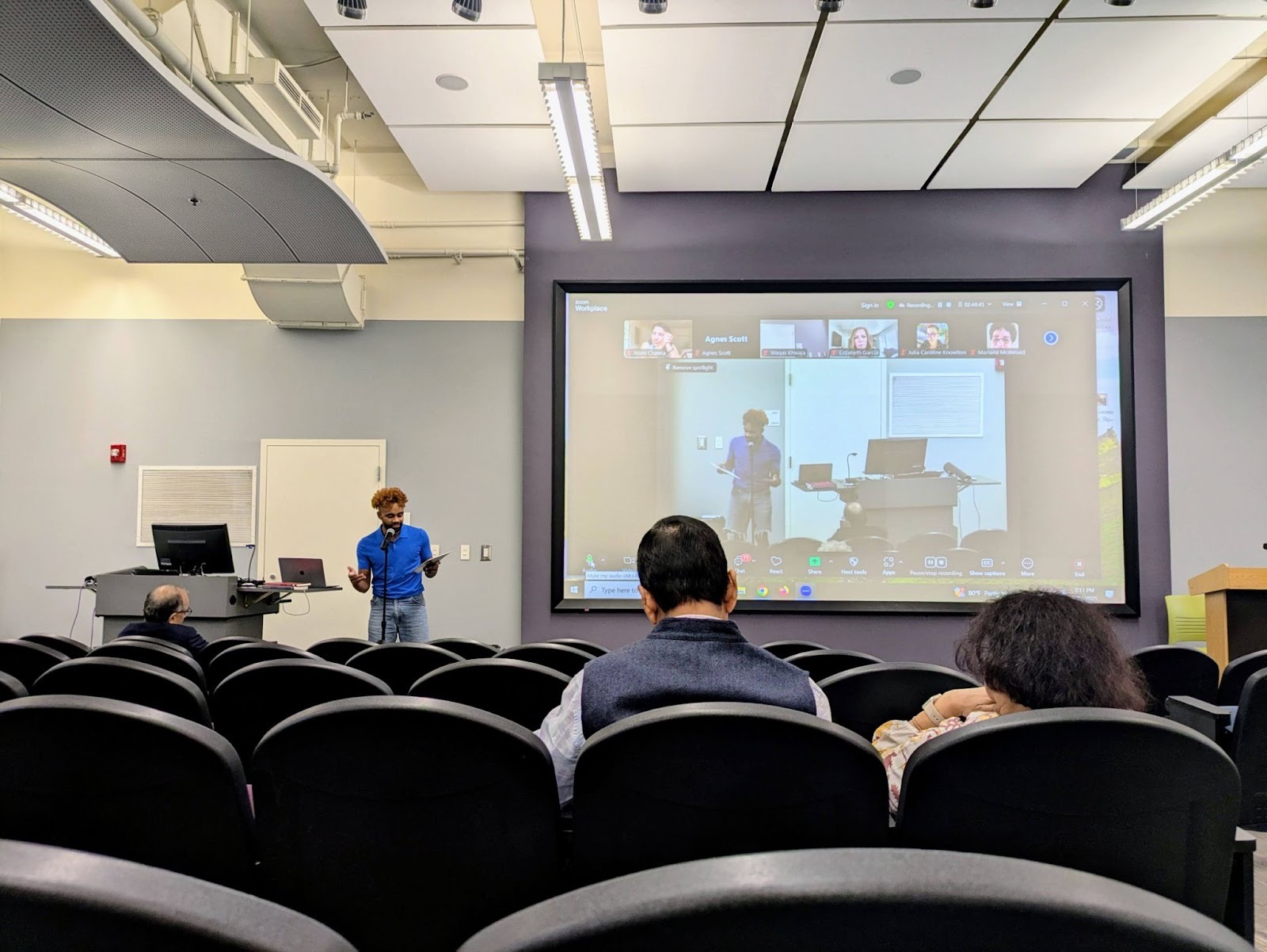
The session continues with works by Dominic Anthony, a Black queer poet who explored different aspects of the human experience across three poems. The first was about a young child who is pregnant, finishing out with the punching line “I’ll be the mother,” a darkly ironic twist of a phrase usually uttered in harmless games of “house”. The second tackled gun violence through the lens of his brother, who nearly died from it, walking the edge of being “almost-dead” and “almost-alive.” Finally, he read a piece that was lighter, but no less commanding, about Black queer love “as soft as Mississippi mud.”
Other readings included a protest poem comprised of lines taken from other works and a poem weaving together the idea of women and nature, both by Elizabeth Cranford Garcia, a reading of “Christmas Lullaby for a New-Born Child” by Yvonne Gregory from Young Hughley, a series of micro lyric poems from the ASC French Department’s very own Professor Julia Caroline Knowlton, works read all the way from Morocco by El Habib Louai, a purple-centric poem by Lynn Farmer, Dr. Saba Naser of Georgia State University who read a 1981 poem written by her father in the original Urdu, a poem titled “Our Bread” from Gopal Lahiri who has published around thirty books, Rupert Fike’s poem “Convergence-1968” about the hippie movement of the 1960s, and selections read by Franklin Abbott from his new book My Ordinary Life which blended his personal life with the political scape of the modern day in a way that made the way he experiences the world accessible to his readers.
The session also featured works read by one former Scottie and one current one! Danielle Holliday, who just graduated from Agnes in the spring with a concentration in political science, read several poems in person. Her intentional gestures and compelling inflection lent her work an ardent quality that few other poets had been able to capture as energetically. Being in the room as she read, made clear her passion and dedication to her craft. Lili Rogers, a first-year student at Agnes who intends to major in creative writing, read two original works, both written for her first ASC writing class: Professor Alan Grostephan’s Multigenre Writing course. She read two poems, one focusing on how depression manifests within the narrator and another on the politicization of the death of Charlie Kirk. Lili told me about how she studied writing in high school, where she fell in love with creative writing and worked on plays, short stories, and poetry. On the topic of her current studies at Agnes, she says that she enjoys getting different perspectives on writing from new professors, especially learning more about poetry from someone who loves it. It is abundantly clear upon hearing her read that, despite being hardly one semester into her Agnes career, Lili has an incredible voice that comes through in her work and a knack for choosing topics that she cares deeply about. On her choice in topics, Lili said that she chose things that she believes affect the greater world around her and contribute to what she describes as the “Political War in America.” She says she will absolutely be getting involved further with the ASC English Department and their subsequent events, and that she found reading for an audience “really rewarding because I was able to share my opinion in my artistic form that I take great pride in.”
At the end of the day, 100k Poets for Change brought together poets from all walks of life to share their art with a wider audience and inspire each other, moving away from a world that focuses so strongly on the individual that collective art goes by the wayside.